Safety File South Africa | Site-Specific Safety File Compilation
Professional, site-specific safety file compilation for contractors and businesses across South Africa — from R4,000 ex VAT. OHS Act 85 of 1993 and Construction Regulations 2014 compliant.
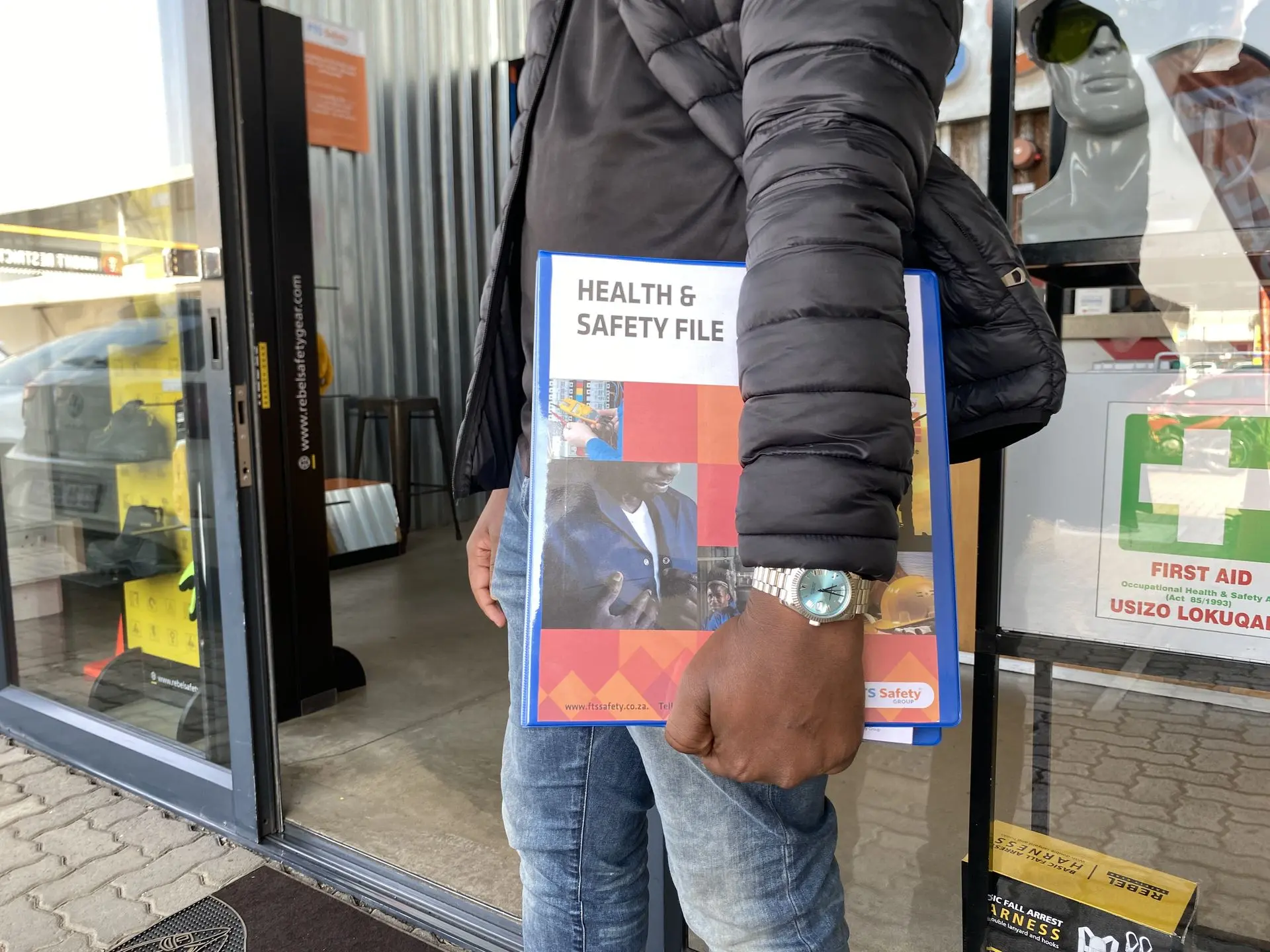
5,000+ Safety Files Completed | South Africa-Wide | Audit Guarantee | 24-Hour Urgent Turnaround Available
Request A Quote
Prefer to talk it through? Call us on 031 569 1555.
What Is a Safety File?
A safety file is a structured set of legally required documents that proves a site, contractor, or employer has identified risks, appointed responsible people, trained staff, and put controls in place before and during work. It's not one document — it's a complete, organised record covering legal appointments, risk assessments, method statements, training and medical records, emergency procedures, and inspection registers.
Under the Occupational Health and Safety Act 85 of 1993 and the Construction Regulations 2014, a safety file must be kept on site and made available for inspection by the Department of Employment and Labour, and by the client or principal contractor overseeing the project.
Is a Safety File a Legal Requirement in Durban and Across South Africa?
Yes. Under the Occupational Health and Safety Act 85 of 1993 and the Construction Regulations 2014, a documented safety file is a legal requirement for construction, maintenance, and other high-risk work in South Africa. The file must be available on site for inspection by the Department of Employment and Labour, and by the client or main contractor overseeing the project.
A safety file is not a single document — it's a structured set of records proving that a site, contractor, or employer has identified risks, trained staff, and put controls in place before and during work. Missing or incomplete files can result in a contravention notice, a stop-work instruction, or disqualification from a tender.

What Documents Are Required for a South African Safety File?
A compliant South African safety file is built from twelve core components. FTS Safety Group compiles all twelve as standard + Daily safety task instructions (used as part of tool box talks for daily work instructions)
1. Letter of Good Standing (Compensation Fund / COID registration proof)
2. Signed 37.2 Mandatory Agreement between client and contractor
3. Site-specific Health and Safety Plan
4. Task-specific Risk Assessments
5. Fall Protection Plan (for any work at height)
6. Method statements for high-risk activities
7. Proof of employee safety induction and training records
8. Medical fitness certificates for relevant employees
9. Emergency preparedness and evacuation procedures
10. Incident, accident, and near-miss registers
11. Legal appointments (16.2 appointee, safety officer, first aiders, fire marshals)
12. Inspection checklists (tools, equipment, scaffolding, PPE)
This is for any standard file . Any task specific file is dictated by the client spec
What Documents Are Required for a South African Safety File?
A compliant South African safety file is built from twelve core components. FTS Safety Group compiles all twelve as standard.
Letter of Good Standing
Proof of Compensation Fund (COID) registration, confirming the business is covered for workplace injury claims — a document most principal contractors will not allow site access without.
Signed 37.2 Mandatory Agreement
A legal agreement between client and contractor under Section 37(2) of the OHS Act, formally assigning health and safety duties and liability to the contractor for the duration of the work.
Site-Specific Health and Safety Plan
A plan describing how health and safety will be managed on this specific site — not a generic template, but one reflecting the actual scope, hazards, and sequence of work.
Task-Specific Risk Assessments
Written assessments identifying the hazards of each task being performed on site, the people exposed to them, and the controls put in place to reduce that risk.
Fall Protection Plan
Required for any work at height. Sets out the fall protection measures, equipment, rescue procedures, and competent persons responsible for managing height-related risk.
Method Statements
Step-by-step safe work procedures for high-risk activities — such as excavation, lifting, hot work, or working at height — describing exactly how the work will be carried out safely.
Proof of Employee Safety Induction and Training
Records confirming that everyone on site has been inducted to the specific hazards of that site and holds the relevant safety training or competency certification.
Medical Fitness Certificates
Valid medical certificates confirming employees are physically fit for the specific work they'll be doing, particularly relevant for work at height, confined spaces, or physically demanding roles.
Emergency Preparedness and Evacuation Procedures
Documented emergency response plans, evacuation routes, assembly points, and emergency contact details specific to the site.
Incident, Accident, and Near-Miss Registers
Logs used to record and track any incidents, accidents, or near-misses on site — a legal requirement and a key document auditors check first.
Legal Appointments
Formal, signed appointments for key safety roles — including the 16.2 appointee, safety officer, first aiders, and fire marshals — confirming who is legally responsible for what.
Inspection Checklists
Regular inspection records for tools, equipment, scaffolding, ladders, and PPE, proving equipment is checked and safe to use on an ongoing basis.
Daily safety task instructions (toolbox talks) are compiled as standard alongside the above. Any task-specific file is shaped by the client's specification.
Who Needs a Safety File?
A safety file is typically required for construction, maintenance, engineering, and other higher-risk work — though exact requirements depend on the scope of work, applicable regulations, and client specifications.
Businesses that typically need one:
- Contractors and subcontractors
- Principal contractors managing multiple trades
- Maintenance companies working on client sites
- Engineering and manufacturing contractors
- Facilities management companies
- Telecommunications contractors
- Shopping centre and retail contractors
- Schools, offices, and call centres undergoing construction or refurbishment work
How the Safety File Process Works
1. Consultation — FTS assesses your business, site, and project requirements.
2. Compilation — Consultants compile a fully compliant, site-specific safety file covering all 12 required components.
3. Delivery — Standard turnaround applies; a 24-hour urgent turnaround is available (Ts&Cs apply).
4. Coaching — A complimentary 15-minute session on how to implement and maintain the file on site.
FTS Safety Group Compliance Standard
Every safety file compiled by FTS Safety Group is structured to be 100% compliant with the Occupational Health and Safety Act (Act 85 of 1993) and the Construction Regulations 2014.
Over 5,000 safety files have been completed for South African contractors, shopping centre tenants, call centres, schools, offices, and cultural centres. FTS guarantees its work will pass client and Department of Employment and Labour audits — clients remain responsible for maintaining the file on site once delivered.
Site-Specific vs. Generic Safety Files — Why It Matters
A generic safety file template covers the basics, but it won't reflect the actual risks, layout, or scope of your project — and most principal contractors will reject it for exactly that reason.
A site-specific safety file is built around:
- The actual hazards present on that site, not a generic industry checklist
- The client's specific safety specification and site rules
- Risk assessments that match the real activities being performed
- Legal appointments that match the people actually working on the project
- Method statements that correspond to the real sequence of work
FTS Safety Group compiles every file to be site-specific from the start — not a template with your company name swapped in.
Why Choose FTS Safety Group
- 5,000+ safety files completed for contractors, shopping centres, schools, call centres, and offices across South Africa
- Audit guarantee — if your file fails a Department of Labour audit due to an error on our part, we'll correct it at no charge
- 24-hour urgent turnaround available, standard turnaround 2–3 business days
- National service, based in Durban with branches in Pietermaritzburg, Cape Town, and Johannesburg
- Free 15-minute coaching session included with every file, so your team knows how to implement and maintain it on site
Trusted by Leading Companies Across Industries
![alt="[MUHAN ENERGY] logo"](/web/image/2134538-7746f5c9/Black%20White%20Minimalist%20Square%20Frame%20Fashion%20Custom%20Tailor%20Logo%20%283%29.png)
![alt="[C&H COMMUNICATION AND HOSPITAL SYSTEMS] logo"](/web/image/2134534-57b679e3/unnamedgb.png)
![alt="[akeso] logo"](/web/image/1516951-03b1c017/dg.png)
![alt="[DUN AIR] logo"](/web/image/1518223-f91bb23d/Untitledmk.jpg)
![alt="[M PROJECTS] logo"](/web/image/1516952-ba61d39a/Untitledwe.png)
![alt="[Outworx] logo"](/web/image/1516953-89ebe136/Untitled.png)
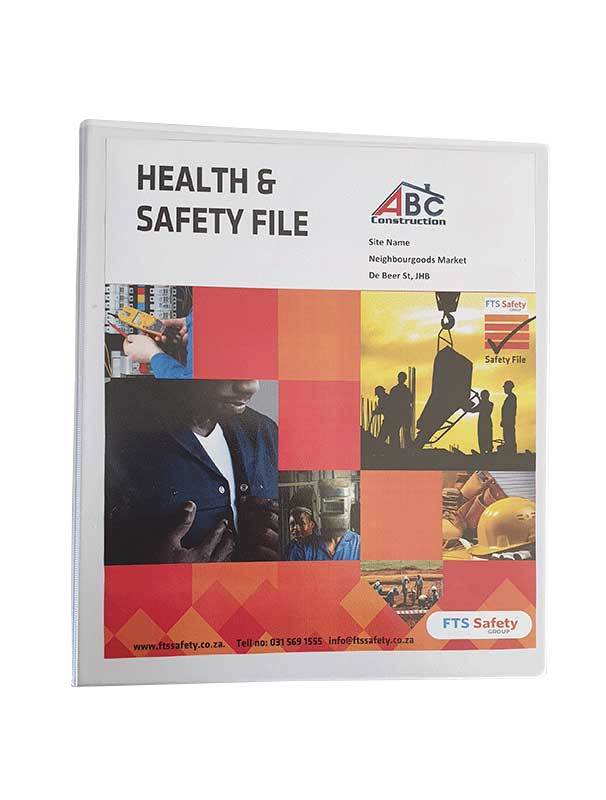
Our Safety File Guarantee
Over 5,000 files completed and guaranteed to pass audit — though maintaining the file on site remains your responsibility once delivered. FTS Safety Group is based in Durban and services contractors nationally, including Pietermaritzburg, Cape Town, and Johannesburg... with 24-hour turnaround available when needed (Ts&Cs apply).
Industries We Serve
Construction | Maintenance | Manufacturing | Engineering | Telecommunications | Facilities Management | Shopping Centres | Schools & Offices
Client Reviews
"Good day Leanne & Nsika Trust that you are both well. I would like to thank you both for your amazing support and assistance in compiling our Safety Files. We have received extremely good feedback from National Brands - Snackworks and have also advised us that they will be using our File as a standard for their suppliers to submit. Unilever Boksburg was also very pleased in the way the file was compiled and represented. Thank you both for always assisting us and ensuring that all relevant information is adhered to.
We also appreciate the timeous feedback that we have received from you both. We look forward to continuing working with you for our future projects as well."

"Good Morning Leanne & Gert, We would like to express our appreciation to Gert Hendriks for coming to our offices to complete our OHS audit. He explained everything with such clarity and patience, we cannot thank him enough. The professionalism was outstanding, and Gert spent a long time with us.
Leanne arranged everything with professionalism, and arranged everything within one day on 2nd June. By then, Gert was here on the 4th June, and our file was ready and completed. Our file was ready within 24 hours of our call and Gert came on the 4th June. I honestly feared the audit, but it went so smoothly, and we obtained our Compliance Certificate via email today, the 9th of June. I cannot recommend FTS Safety Group enough; we will definitely be using this company again. Many Thanks,"

Frequently Asked Questions
Does FTS Safety Group work outside Durban?
FTS Safety Group Safety Management Department is based in Durban. With training branches in Cape Town, Johannesburg and Pietermaritzburg, and compiles safety files for clients throughout South Africa.
How much does a safety file cost?
FTS Safety Group's safety file service starts at R4000, including consultation, compilation, delivery, and a free 15-minute coaching session.
How fast can I get a safety file?
We compile and deliver complete, audit-ready safety files within 24 hours for urgent requests. Standard turnaround times typically range from 2 to 3 business days, depending on your specific project scope and risk profile. Every file is fully customized to your site requirements before delivery.
What support Does FTS Safety Group compile safety files for Durban-based sites?
FTS Safety Group specializes in compiling site-specific safety files tailored for Durban, Pietermaritzburg, and across KwaZulu-Natal. Our files are specifically structured to pass strict site-entry audits and official inspections by the KZN Provincial Department of Employment and Labour.
(We compile files for sites throughout South Africa)
What documents are required for a South African safety file?
A compliant file includes a Letter of Good Standing, a signed 37.2 Mandatory Agreement, site and task-specific risk assessments, a Fall Protection Plan where applicable, training and medical fitness records, emergency procedures, incident registers, and legal appointments. See the full 12-part checklist above.
Is a safety file a legal requirement in Durban and across South Africa?
Yes. Safety files are a legal requirement for construction, maintenance, and other high-risk work anywhere in South Africa, including Durban — under the Occupational Health and Safety Act 85 of 1993 and the Construction Regulations 2014. FTS Safety Group is based in Durban and compiles files that are structured to pass inspection by the KZN Provincial Department of Employment and Labour, as well as labour centres in Pietermaritzburg, Cape Town, and Johannesburg.
Who is responsible for maintaining a safety file after it's delivered?
FTS Safety Group compiles a fully compliant, site-specific safety file, but maintaining it on site — keeping registers updated, adding new inductions, logging inspections, and filing incident records as work progresses — remains the client's responsibility once the file is delivered. We include a free 15-minute coaching session with every file so your team knows exactly what to keep updated and how.
Can I use a generic safety file template instead?
A generic template can leave gaps that principal contractors and auditors are trained to spot — it won't reflect your site's actual hazards, your client's specific safety specification, or the real sequence of work being performed. This is often why generic files are rejected at site entry. FTS Safety Group compiles every file to be site-specific from the start, not a generic template with your company details swapped in.
How often should a safety file be updated?
A safety file should be reviewed and updated whenever there's a material change on site — new personnel, new equipment, an extended scope of work, expired medical certificates or training records, or a new phase of the project. Many contractors also review their file at each site audit or client inspection to confirm everything is current. Get in touch if you'd like FTS Safety Group to review or update an existing file.
What documents are required for a South African safety file?
A compliant file includes a Letter of Good Standing, a signed 37.2 Mandatory Agreement, site and task-specific risk assessments, a Fall Protection Plan where applicable, training and medical fitness records, emergency procedures, incident registers, and legal appointments. See the full 12-part checklist above.
What support do we offer after your safety file is delivered?
We provide comprehensive post-delivery support to ensure your site entry is successful. This includes free adjustments if a principal contractor requests layout modifications, dedicated guidance through your safety file submission, and continuous advisory support for your local site team.